
AI Social Media Graphics: Stop Looking Like Every Other Brand
62% of small businesses use the same templates. Here's why your Instagram looks identical to your competitor's—and how AI-generated originals solve both the volume and differentiation problems.
Image Studio Team
Image Studio
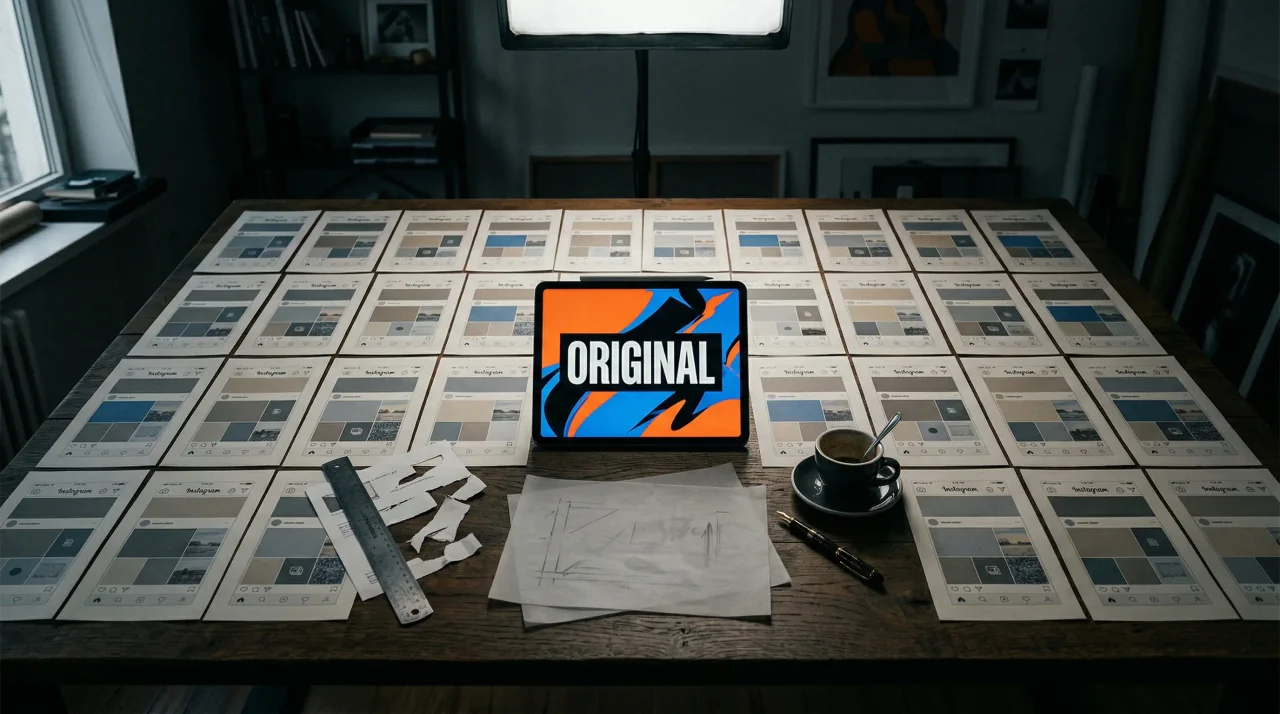
Open Instagram. Scroll through ten business accounts in your industry. Can you tell them apart without reading the text?
The geometric shapes are the same. The gradient backgrounds are the same. The photo grids with the same filters, the same fonts, the same "professional" aesthetic that somehow manages to look both polished and forgettable. You're not imagining it. According to Forrester Research, about 62% of small businesses use ready-made templates for their visual content. The result: a sea of sameness where brands get lost among competition using identical building blocks.
Here's the uncomfortable truth: template tools like Canva solved accessibility. They made professional-looking design possible for anyone with an internet connection. But they also created a ceiling. When everyone uses the same templates, "professional-looking" becomes "interchangeable." Your brand's Instagram grid starts resembling a commodity.
This post examines why the current approach to social media visuals is breaking down, what the volume demands actually look like, and how AI-generated originals—not AI-enhanced templates—offer a way out.
The Template Trap: How We Got Here
Canva has over 150 million monthly users. That's not a criticism—it's a revolution in democratized design. A decade ago, creating polished social media graphics required either design skills or a designer on staff. Canva and similar tools collapsed that barrier.
But every revolution has unintended consequences.
The same templates that made design accessible made design uniform. When a small bakery in Austin, a law firm in Boston, and a SaaS startup in Berlin all reach for the same "modern minimal" Instagram post template, they end up looking like variations on a theme rather than distinct brands.
The problem intensified with the rise of AI-enhanced template tools. Now brands can generate entire visual systems in minutes—complete with stock layouts, placeholder content, and that distinctive "AI-assisted template" aesthetic. Forrester found that about 40% of websites in 2024 use AI-generated visuals, with users increasingly complaining that they all look the same.
The template approach made sense when the alternative was expensive or inaccessible. But in 2026, the question isn't "can we afford professional-looking graphics?" It's "can we afford to look exactly like everyone else?"
The Volume Problem Nobody Talks About
Before solving differentiation, we need to acknowledge the scale of the challenge.
Here's what the data says about posting frequency in 2026:
Instagram: 3-5 feed posts per week, plus 2-4 Reels, plus Stories daily or near-daily. That's roughly 15-25 pieces of visual content per week for one platform.
LinkedIn: 3-5 posts per week for B2B-focused accounts. Each post performs 2x better with images or native video compared to text-only.
Facebook: 3-7 posts per week, with image, video, and text all performing within one percentage point of each other—meaning you still need visuals to compete.
Twitter/X: 2-3 posts daily, with visuals consistently outperforming text-only tweets.
TikTok: 3-5 videos weekly at minimum, with some data suggesting 11+ posts per week yields 34% more views.
Add these up. A brand maintaining presence across just three platforms needs 25-40 pieces of visual content per week. That's 100-160 pieces per month. Over a thousand pieces per year.
Now consider the constraint: each piece must be on-brand, platform-appropriate, and—if you want to stand out—visually distinctive.
This is where the template approach breaks down. Templates solve for speed, not differentiation. They get you to 25 posts per week, but they also guarantee that your visual identity becomes a remix of everyone else's visual identity.
Why Visual Content Still Wins
Before abandoning visuals for text-only posts (tempting when facing the volume problem), the data is clear: visual content dramatically outperforms text across every platform.
Posts with images generate 2.3 times more engagement compared to text-only updates. Video content accounts for over 60% of total social media consumption in 2026. On LinkedIn, posts with images or native video receive 2x more comments compared to text-only.
But here's the nuance: the type of visual matters.
On Threads, videos claim first place for engagement at 5.55%—22% ahead of images and nearly double text posts. On Instagram, static image posts are driving 6.2% engagement while Reels sit at just 3.5%—a surprising resurgence of static images over video reels. On Facebook, format matters less than almost anywhere else, with images, video, and text all landing within one percentage point of each other.
The takeaway: you can't opt out of visual content without accepting a significant engagement penalty. But you also can't phone it in with generic visuals and expect to break through.
The Canva Ceiling
Template tools hit a ceiling when differentiation matters more than accessibility. Here's how that ceiling manifests:
Limited variation: Templates are designed to be customizable within bounds. Swap the photo, change the text, pick your colors. But the underlying structure—the composition, the visual rhythm, the negative space—stays the same. Your competitor customizing the same template arrives at the same place you did.
Recognizable aesthetics: Frequent social media users develop pattern recognition for template-generated content. That particular geometric accent, that specific gradient style, that exact font pairing—they've seen it before, even if they can't articulate why your post feels familiar.
Photography limitations: Templates work best with stock photography. But stock photography is, by definition, generic. The same photo of a "diverse team collaborating" appears on thousands of company pages. It signals "we have a marketing budget" more than it communicates anything specific about your brand.
Speed vs. craft: Templates optimize for "good enough, fast." They're perfect for getting content out the door. But "good enough" compounds into "forgettable" over time. Your brand's visual identity becomes the template's visual identity, shared with everyone else using that template.
AI-Generated Originals: A Different Approach
The alternative isn't more templates. It's generating original imagery for each use case.
This sounds expensive. It sounds slow. It sounds like the old world where you needed a designer for everything. But AI image generation has fundamentally changed the economics.
Here's what AI-generated social media graphics look like in practice:
Per-post originals: Instead of customizing a template, you generate imagery specifically for each post. The background isn't a gradient from a template library—it's a visual that supports your specific message.
Brand-specific aesthetics: AI image generators can maintain consistency through prompt engineering—repeating color codes, style descriptors, and compositional preferences across generations. The result is visual consistency without visual sameness.
Impossible imagery: Templates are limited to what's achievable with photos, shapes, and text. AI generation can create scenes that don't exist, concepts that can't be photographed, and visual metaphors that would require expensive custom illustration.
Batch generation: Need five variations on a concept? Generate them simultaneously. Need platform-specific versions—square for Instagram, landscape for LinkedIn, vertical for Stories? Generate each aspect ratio with the same prompt foundations.
The volume problem that made templates necessary is now solvable with original imagery.
Platform-by-Platform Considerations
Each platform has its own visual culture. AI-generated graphics must match these expectations or risk looking out of place.
Instagram (Square + Stories + Reels Covers)
Instagram rewards aesthetic coherence. Your grid is a portfolio. AI generation should maintain a consistent visual system—recurring color palettes, compositional styles, and mood—while varying the specific content.
Square posts (1080x1080): The workhorse format. AI generation shines here because you're creating a single, impactful image rather than assembling template components. Focus on bold focal points and high contrast—Instagram feeds are visually competitive.
Stories (1080x1920): Vertical format with UI overlays at top and bottom. AI generation should leave clean space in safe zones for text and engagement elements. The ephemeral nature means you can experiment more freely here.
Reels covers: A single frame that represents the video. AI generation can create custom cover images that match your visual system rather than accepting a random frame grab.
LinkedIn (Professional, 1200x627)
LinkedIn's visual culture is more restrained. Bright colors and playful aesthetics that work on Instagram feel out of place here. AI generation for LinkedIn should emphasize:
- Clean, structured compositions
- Professional color palettes (navy, charcoal, muted accents)
- Conceptual imagery that supports business ideas
- Charts, diagrams, and data visualization aesthetics
The format is landscape (1200x627), which naturally suits AI generation—you have room for composition without fighting vertical constraints.
Twitter/X (In-Feed Images)
Twitter images (1600x900) appear in fast-scrolling feeds where you have milliseconds to register. AI generation for Twitter should prioritize:
- Maximum visual impact at small sizes
- High contrast between subject and background
- Bold, simple compositions that read instantly
- Images that create curiosity or prompt engagement
Preview crops to center, so avoid placing critical elements at extreme edges.
Facebook is the most forgiving platform for visual format—images, video, and text all perform within one percentage point of each other. But this doesn't mean visuals don't matter. It means the bar is lower, not absent.
AI generation for Facebook can lean more informational—diagrams, infographics, and explanatory visuals that wouldn't work on more aesthetic-focused platforms.
The Batch Creation Workflow
The volume problem requires a systematic approach. Here's how to create 15-25 pieces of visual content per week without defaulting to templates:
Step 1: Content planning. Identify the week's posts by topic and platform. Group similar content themes—you'll generate these together.
Step 2: Prompt foundations. Establish your brand's visual DNA in reusable prompt components:
- Color palette (hex codes)
- Style descriptors (clean corporate, bold graphic, minimal editorial)
- Compositional preferences (product centered, negative space for text, etc.)
- Quality anchors (references to styles, photographers, or aesthetics that inform your brand)
Step 3: Batch generation. Generate 2-4 variations per concept. Not minor tweaks—fundamentally different visual approaches to the same message. This gives you options and builds a library for future use.
Step 4: Platform adaptation. Take winning concepts and regenerate for platform-specific dimensions. A 1:1 Instagram post becomes a 16:9 LinkedIn image becomes a 9:16 Story.
Step 5: Text compositing. AI-generated text is unreliable. Generate images with clear zones for text overlay, then add text in a design tool. This takes minutes per image. The same rule applies when the asset is a sales-critical cover or retailer thumbnail, not just a social post — our AI book cover generator guide for indie authors walks through that thumbnail-first workflow in detail.
This workflow produces original imagery at template-tool speed. The initial setup takes longer, but once your prompt foundations are established, generation becomes faster than template customization.
What Actually Differentiates
Template differentiation happens at the margins—this color instead of that color, this font instead of that font. AI-generated differentiation happens at the core.
Unique imagery: Your social feed contains images that exist nowhere else. Your competitor can't download them. Your audience hasn't seen them before. This is table-stakes differentiation that templates structurally cannot provide.
Conceptual range: Templates are limited to what's photographable and composable. AI generation can create visual metaphors, abstract concepts, and impossible scenes that communicate ideas templates can't touch.
Consistent distinctiveness: The paradox of brand identity—you need to be consistent enough to be recognizable but distinctive enough to be memorable. AI generation with well-developed prompt foundations achieves both. Each image is original, but all images share visual DNA.
Speed to concept: When you think of a visual, you can create it. No searching template libraries for "close enough." No compromising on stock photography. The image in your head can become the image in your feed.
The Objection: "AI Images Look AI-Generated"
Valid concern. Bad AI images have tells: plastic skin, impossible geometry, garbled text, that distinctive "AI sheen."
The counter: bad template images have tells too. The same geometric accents. The same gradient backgrounds. The same stock photography. The difference is that template tells are socially acceptable because we're used to them.
AI image quality has improved dramatically. The gap between "obviously AI-generated" and "could be a custom illustration or photography" has narrowed to the point where quality depends more on prompt craft than model limitations.
And here's the thing: distinctive AI imagery that's clearly not a photo may read as more intentional than obviously templated content. A brand using surreal, impossible visuals is making a creative choice. A brand using recognizable Canva templates is making a convenience choice.
The Real Cost Calculation
The objection to AI generation is usually cost or complexity. Let's examine both.
Template approach:
- Canva Pro: ~$120/year
- Stock photography: $0-500/year depending on needs
- Time per post: 10-30 minutes of customization
- At 100 posts/month: 17-50 hours/month
AI generation approach:
- AI image generation credits: ~$20-100/month depending on volume
- Image Studio or similar tool: ~$50/month
- Time per post: 5-15 minutes (prompt + generation + selection)
- At 100 posts/month: 8-25 hours/month
The direct cost is similar or slightly higher for AI generation. The time investment is often lower once the workflow is established. But the real difference is in the output: original imagery vs. template variations.
If differentiation matters—if looking like your competitors is costing you engagement, recognition, or customers—the ROI calculation shifts dramatically.
What This Means for Your Brand
The era of template-driven visual sameness is ending, not because templates stopped working, but because the alternative became viable.
In 2026, brand presence on social media faces a harder question than "can we produce enough content?" The question is: "When everything can be generated, what makes your brand feel like it was made on purpose?"
Templates were the answer to scarcity—scarce design skills, scarce time, scarce budget. AI generation is the answer to abundance—abundant imagery, abundant variation, abundant originality, at scale.
The brands that will stand out aren't the ones with bigger design teams or more template subscriptions. They're the ones who recognized that visual differentiation is now a choice, not a constraint.
Your competitor's Instagram doesn't have to look like yours. Yours doesn't have to look like theirs.
The tools exist. The economics work. The only question is whether you keep reaching for the same templates everyone else uses, or whether you start creating imagery that exists nowhere else.
Image Studio generates original social media graphics for every platform and use case. Skip the template library and create visuals that belong only to your brand.
Related Articles
AI Product Photography Guide for Small Stores
How small stores can use AI product photography for marketplace listings, social posts, and site assets without losing consistency.
LinkedIn Headshot AI Guide for 2026
A practical guide to LinkedIn headshot AI: likeness, lighting, trust signals, usage rights, and whether the final image earns the meeting.
Best AI Headshot Generators Compared (2026): 7 Services Tested on Quality, Speed, and Price
We tested 7 AI headshot generators on the same photo set. Here's what actually works — and what costs way more than it should.
Ready to create images that convert?
Generate headshots, thumbnails, and covers that stay on brand—no photo shoots or design rounds.
Launch Image Studio