
AI Product Photography: Professional E-Commerce Images Without a Studio
Professional product photography costs $25-75 per image. AI generation costs 80% less. Here's what actually works for e-commerce sellers.
Image Studio Team
Image Studio
Your first product photo cost you $47.
That was the quote from the local photographer. One product, white background, basic retouching. You had 50 SKUs to shoot, so you did the math: $2,350 just to get your store live. Then you remembered you needed lifestyle shots for social media. And seasonal variations for holiday campaigns. And updated angles when you changed the packaging.
The total kept climbing. Most small e-commerce sellers face the same arithmetic. Professional product photography runs $25-75 per basic image, $50-150 for styled shots with props, and $250+ for lifestyle photography with models and creative direction. A catalog of 50 products shot professionally costs $1,250-3,750 before you've sold a single unit.
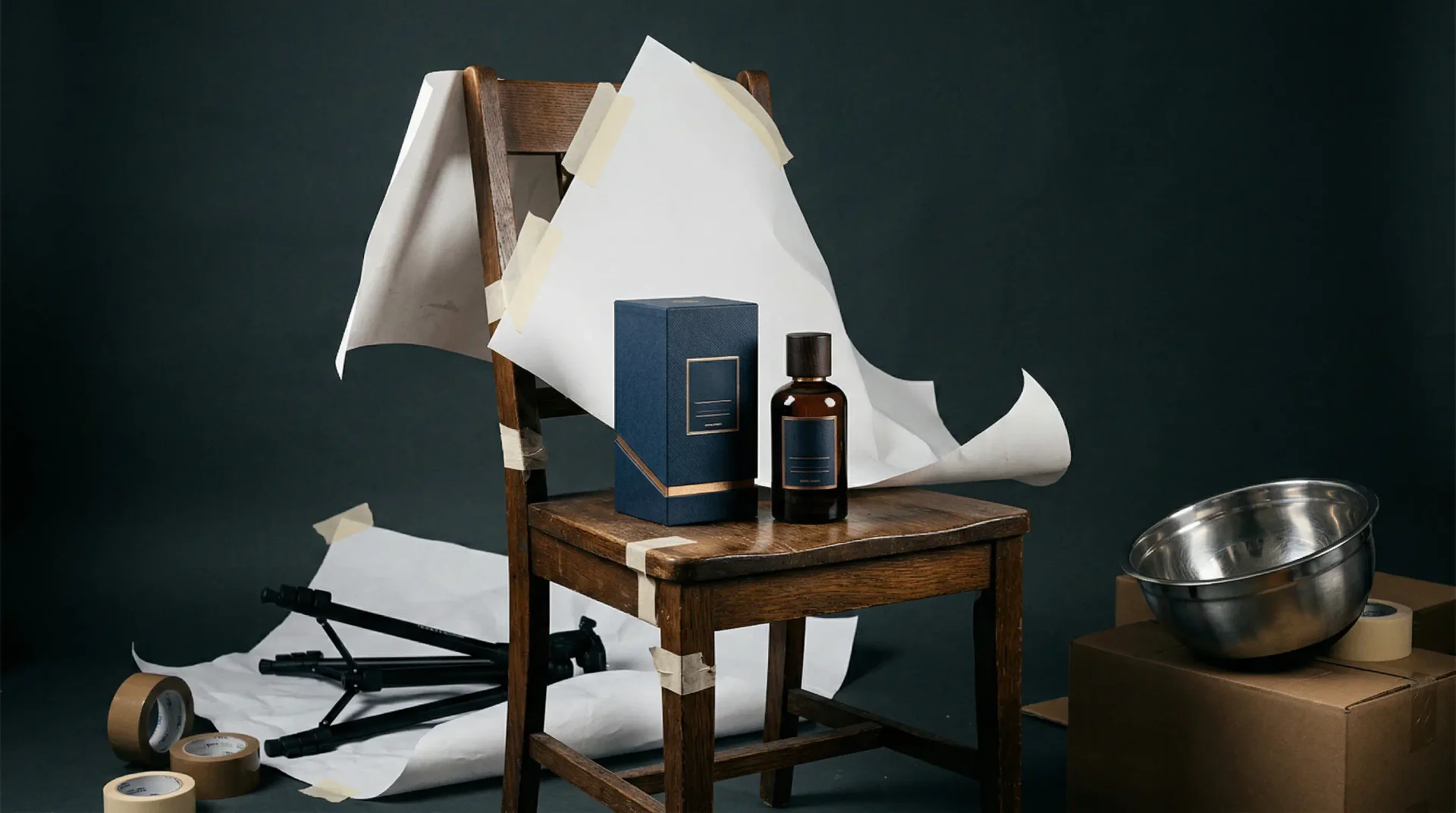
So you did what every bootstrapped seller does. You cleared the kitchen table, taped a white sheet to the wall, and shot your products with an iPhone. The photos looked fine. Fine enough. You convinced yourself customers wouldn't notice.
They noticed.
Use this page fast: if you need the practical workflow first, jump to the small-seller workflow; if you are deciding whether AI is safe for your category, read the honest limitations; if you sell on marketplaces, skim platform-specific requirements.
The 60-Second Fit Check
| If your situation looks like this | Default move | Why this is the right starting point | |---|---|---| | You have 20-200 SKUs and weak iPhone photos | Shoot real products once, then use AI background replacement | You preserve product accuracy while fixing the obvious quality gap fast | | You need Amazon- or Shopify-ready white-background images this week | Use AI enhancement for catalog shots first | This is the cheapest path to compliant, consistent product pages | | You need lifestyle images for ads or social but cannot fund a full shoot | Generate lifestyle context from your best real hero shots | You get contextual persuasion without inventing a fake product | | Your products are reflective, transparent, or detail-sensitive | Use AI for cleanup, but hire a photographer for hero assets | Glass, metal, liquids, and intricate finishes still punish fake-looking shortcuts | | Your top 10 products drive most revenue | Spend human budget there, then use AI for the long tail | That is where creative direction and precision still compound hardest |
The Conversion Tax You're Paying
Product image quality is the single largest controllable factor in e-commerce conversion rates. The research is unambiguous.
High-resolution product photos convert 94% better than low-resolution alternatives. A 28% increase in image size drives a 63% increase in conversions. Listings with 7+ images convert 32% higher than those with 4 images. 75% of online shoppers rely primarily on product photos to make purchasing decisions.
Building a consistent visual brand? Product photos are just one piece. Learn how to maintain brand consistency across all AI-generated images — from product shots to social graphics to marketing materials.
If you need product photos optimized for specific platforms, read our data-backed guide to AI product photography that actually drives conversions with platform-specific benchmarks.
The gap between professional photography and amateur shots isn't aesthetic preference. It's revenue.
Amazon sellers see this most clearly. The platform's 2026 requirements specify pure white backgrounds (RGB 255,255,255), minimum 1000px on the longest side (2000px recommended), and product filling 85% of the frame. But requirements are table stakes. Optimization is where conversions happen.
Listings with optimized images convert at 2-3x the rate of those with mediocre visuals. One case study for a confectionery brand achieved a 65% increase in conversion rate using image optimization alone. Mobile matters even more: 18% higher mobile conversion for listings using 2000px images versus the minimum 1000px.
The difference between a $10,000/month store and a $30,000/month store often comes down to photography quality. That's not hyperbole. It's arithmetic applied to conversion rate differentials.
What Actually Makes Product Photos Convert
Professional product photography follows specific principles. Understanding them helps you evaluate whether AI-generated images meet the bar.
Studio Shots: The E-Commerce Foundation
Every marketplace and platform defaults to the same baseline: clean white background, product clearly visible, no distractions. This isn't creative preference. It's functional.
Lighting separates professional from amateur. Side lighting at 45 degrees reveals texture and form. It shows the grain of leather, the weave of fabric, the brushed finish of metal. Front lighting flattens everything. Your iPhone flash produces flat, even illumination that makes a $200 bag look like a $20 knockoff.
Shadow grounds the product. Without shadow, products float against the white background like clipart. A contact shadow (the tight shadow directly beneath the product) creates physical presence without drama.
Angle communicates information. Straight-on shots are informational. 15-30 degrees above shows top and front simultaneously. A low hero angle makes products feel substantial. The angle you choose should match what buyers need to evaluate.
Material dictates technique. Glass needs backlighting to reveal transparency. Metal needs large, soft light sources to avoid harsh reflections. Fabric needs side-raking light to show texture. A photographer who lights everything the same way produces inconsistent quality.
Lifestyle Shots: The Conversion Multiplier
Studio shots inform. Lifestyle shots persuade.
Lifestyle photography places products in context: the coffee mug on a sun-lit kitchen counter, the backpack on a hiker's shoulder, the skincare routine on a marble bathroom vanity. These images don't just show the product. They show the life the product enables.
Amazon data confirms this: adding 3 lifestyle images to listings drives an 18% conversion rate increase independent of other factors. Pinterest, Instagram, and TikTok commerce depend almost entirely on lifestyle imagery. The platforms that drive discovery favor contextual photography over clinical studio shots.
The catch: lifestyle photography is expensive. You need locations, styling, sometimes models. A single lifestyle shoot can cost $500-2,000 for a handful of images. For small sellers, this historically meant choosing between professional lifestyle imagery and inventory capital.
The Traditional Photography Problem
Let's be specific about what professional product photography actually costs in 2026.
Per-Image Pricing
- Basic white background: $25-75 per image
- Styled shots with props: $50-150 per image
- Lifestyle with location/models: $250-500+ per image
Volume Discounts
Bulk pricing helps, but not enough:
- 1-7 photos: $39/image
- 8-29 photos: $29/image
- 30-49 photos: $25/image
- 50-69 photos: $19/image
- 100+: $12/image
Hidden Costs
Post-production runs $15-75 per image on top of photography fees. Commercial day rates range $3,000-10,000. Rush fees, reshoot fees, and licensing restrictions add up.
For a 50-SKU catalog with basic studio shots, you're looking at $1,250-2,500 minimum. Add 3 lifestyle images per hero product (even just your top 10) and you've added another $7,500-15,000.
The timeline compounds the problem. Professional photography requires scheduling, shipping products to the studio (or photographers to you), waiting for shoots, then waiting again for post-production. Two to four weeks is standard. For sellers operating on thin margins with seasonal inventory, that timeline eats into your selling window.
Where AI Photography Actually Helps
AI product photography tools fall into two categories: background swap/enhancement and full generation. Understanding the distinction matters.
Background Replacement and Enhancement
These tools take an existing photo of your product and transform the setting. You upload an iPhone shot against your kitchen wall. The AI removes the background, adds a clean studio environment or lifestyle context, adjusts lighting to look professional.
This actually works well. You have a real photo of your real product. The AI is changing context, not inventing the product. Results can be indistinguishable from professional photography for most e-commerce applications.
76% of small businesses that adopted AI photography tools in 2025 reported cost savings over 80%. The math is stark: $5-15 per AI-enhanced image versus $25-75 for traditional photography. Same visual quality for catalog purposes.
Full Generation
This is where expectations need calibration.
AI image generators can create photorealistic product images from text prompts or reference images. But they cannot photograph your specific physical product. They generate a plausible version of a product category based on training data.
For some applications, this works: conceptual marketing, mood boards, social media where lifestyle context matters more than product specificity. For product listings where accuracy is essential, full AI generation has significant limitations.
The Honest Limitations
AI product photography is not magic. Here's where it falls short.
Product Accuracy
AI generates based on patterns, not your actual product. If your leather bag has a specific buckle design, particular stitching, a unique handle shape, AI will generate something that looks like a leather bag with buckle, stitching, and handle. Not your buckle, your stitching, your handle.
For private label products that look similar to category templates, this matters less. For differentiated products where specific details drive purchase decisions, AI generation can misrepresent what customers will receive.
Reflections and Transparency
Glass, metal, liquids, and reflective surfaces remain challenging. AI frequently produces physically impossible reflections, incorrect refraction, and inconsistent transparency. A generated image of a glass bottle may have reflections that don't correspond to any logical light source.
Professional photographers spend years learning to light these materials correctly. AI hasn't fully absorbed that knowledge.
The Return Rate Problem
22% of online products are returned because they look different in person than in photos. AI-generated images that enhance or idealize products beyond reality make this worse. The short-term conversion boost from aspirational imagery creates long-term costs in returns, customer service, and damaged reviews.
The safest approach: use AI to enhance real product photos, not replace them.
The Practical Workflow for Small Sellers
Based on what actually works in 2026, here's the cost-optimized approach:
Step 1: Capture Real Product Photos
You still need to photograph your actual products. But the quality bar is lower when AI handles the heavy lifting.
What you need:
- Consistent lighting (window light works, or a $50 ring light)
- Multiple angles of each product
- Close-ups of differentiating details
- Neutral background (doesn't need to be perfect white)
Shoot in good light. Hold steady or use a tripod. Capture the product clearly from each relevant angle. This takes 10 minutes per product once you have a system.
Step 2: AI Enhancement for Studio Shots
Upload your photos to an AI background removal and enhancement tool. Generate clean studio versions with:
- Pure white background (for marketplace compliance)
- Consistent lighting across your catalog
- Professional shadow treatment
- Multiple aspect ratios for different platforms
Cost: $5-15 per image. Turnaround: minutes.
Step 3: AI Lifestyle Context
Take your best hero shot and generate lifestyle variations:
- Kitchen counter for kitchenware
- Desk setup for office products
- Bathroom vanity for beauty
- Outdoor scenes for outdoor gear
The AI adds context to your real product photo. You get lifestyle imagery without the shoot.
Step 4: Know When to Hire
Some situations still call for traditional photography:
- Hero products driving the majority of revenue deserve professional investment
- Complex products with reflective surfaces, transparency, or intricate details
- Brand campaigns where creative direction matters
- Products that don't exist yet (for pre-orders, crowdfunding)
The economics have shifted. AI handles 80% of catalog photography needs. Professionals focus on the 20% where their expertise creates disproportionate value.
Platform-Specific Requirements
Different platforms have different standards. AI tools should output images that meet them.
Amazon
- Main image: pure white background, product fills 85%+ of frame
- 1000px minimum, 2000px recommended
- No text, logos, or watermarks
- 7+ images optimal for conversion
Shopify
- Square 1:1 for product grids
- Multiple aspect ratios for different page sections
- Consistent style across catalog
- Lifestyle images for homepage and social
Instagram/TikTok Shop
- Vertical 9:16 for Stories and Reels
- Square 1:1 for feed
- Lifestyle context outperforms studio shots
- Imperfect/authentic aesthetic often converts better
- Vertical 2:3 optimal
- Lifestyle and in-context imagery dominates
- Text overlay works (unlike Amazon)
- Collections and mood boards drive engagement
The Bottom Line
Professional product photography has been gatekept by cost for most of e-commerce history. Small sellers couldn't afford the $25-75 per image that large brands treated as routine. They shot on kitchen tables and hoped customers wouldn't notice the quality gap.
Customers noticed. And they converted elsewhere.
AI tools have inverted the economics. 76% of small businesses using AI photography report 80%+ cost savings. The quality gap between bootstrapped sellers and funded brands has collapsed. A seller with an iPhone and an AI enhancement tool can produce catalog imagery that competes with professional studios.
The limitations are real: AI can't photograph your actual product, struggles with reflective materials, and can introduce accuracy issues that drive returns. The solution isn't to avoid AI. It's to use it correctly: photograph your real products, use AI for background replacement and enhancement, generate lifestyle context from real hero shots, and invest in professionals for the 20% of images where it matters.
Your first product photo doesn't need to cost $47 anymore. It doesn't need to look like a $47 photo either.
Ready to transform your product photography? Image Studio on Rush generates professional e-commerce images in minutes. Upload your product photo, select your style, and download catalog-ready images optimized for Amazon, Shopify, and social commerce.
Related Articles
AI Product Photography Guide for Small Stores
How small stores can use AI product photography for marketplace listings, social posts, and site assets without losing consistency.
AI Product Photography for Ecommerce: The Conversion Data for 2025
75% of shoppers rely on product photos to buy. Here's what the data says about AI product photography and ecommerce conversion rates in 2025.
LinkedIn Headshot AI Guide for 2026
A practical guide to LinkedIn headshot AI: likeness, lighting, trust signals, usage rights, and whether the final image earns the meeting.
Ready to create images that convert?
Generate headshots, thumbnails, and covers that stay on brand—no photo shoots or design rounds.
Launch Image Studio