
AI Product Photography for Ecommerce: The Conversion Data for 2025
75% of shoppers rely on product photos to buy. Here's what the data says about AI product photography and ecommerce conversion rates in 2025.
Image Studio Team
Image Studio
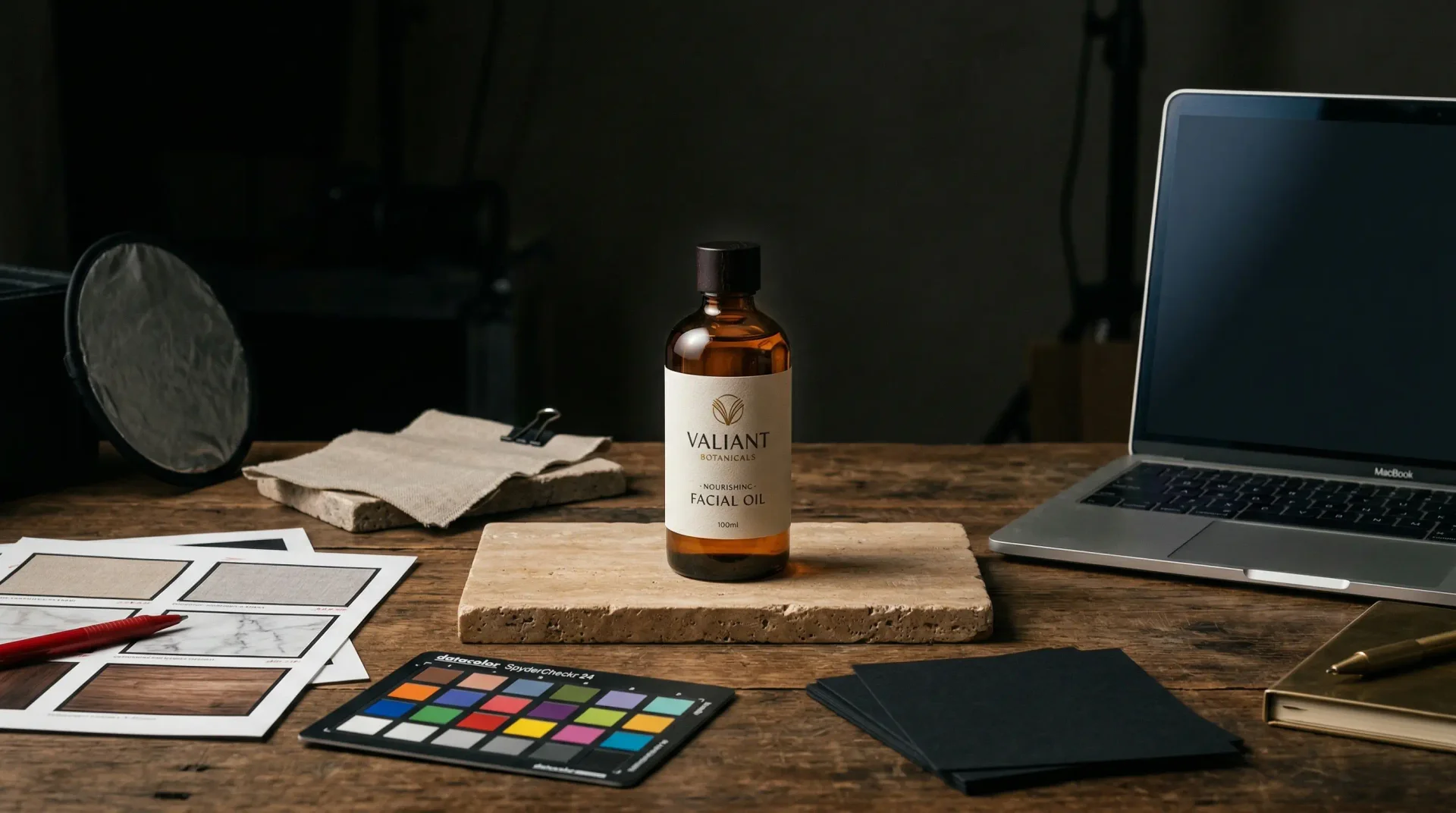
Product photography is not a creative luxury. It is a conversion mechanic.
75% of online shoppers rely on product photos to make purchasing decisions Business Dasher. Not reviews. Not descriptions. Photos. And when those photos are low-quality, 22% of returns happen because the item looked different in the image Business Dasher.
This is why ecommerce brands are shifting to AI product photography. The technology has matured. The data is in. And the conversion improvements are substantial enough that brands ignoring AI photography are effectively paying a tax for doing things the old way.
What the Data Actually Says
A comprehensive study by BigCommerce analyzing 12,000 online stores found that merchants implementing AI-enhanced product photography saw conversion rate improvements ranging from 35% to 67%, with a median increase of 49% Loomreach. This was not a controlled lab test. These were real stores tracked over six-month periods.
| Metric | Traditional Photography | AI-Enhanced Photography | |--------|------------------------|-------------------------| | Avg conversion improvement | Baseline | 35-67% increase | | Revenue uplift for AI adopters | — | 87% report increases EComposer | | Cost per image (lifestyle) | $100-150 | Under $5 | | Time to market | 2-4 weeks | Same day |
Furniture retailer Outer increased product page conversions by 58% after implementing AI-generated lifestyle images. Cost per image dropped from $150 to under $5. Fashion accessories brand Studs saw a 44% conversion increase after using AI to standardize their entire catalog Loomreach.
The pattern is consistent across categories. Electronics and simple products see 30-40% improvements. Fashion, furniture, and lifestyle products often exceed 60% because contextual imagery helps customers visualize ownership.
Why AI Photography Converts Better
Three factors drive the conversion lift:
1. Consistency builds trust.
When every product maintains identical lighting, background, and composition standards, your brand appears more professional. A Shopify conversion study found stores with consistent product photography saw 43% higher trust ratings and 51% better conversion rates Loomreach.
2. Contextual variety matches intent.
Modern AI tools place products in multiple lifestyle settings instantly. A watch can appear on a wrist, on a desk, in a luxury setting, or outdoors—all from one source photo. Research shows this variety increases purchase intent by up to 62% because different customer segments see themselves using the product.
3. Speed enables testing.
Traditional photography makes A/B testing prohibitively expensive. AI tools let you test dozens of variations—different backgrounds, angles, lighting styles—and automatically optimize based on performance data. This continuous optimization creates a compounding advantage that traditional photography cannot match.
The Cost Reality
Traditional product photography for 100 products typically costs $5,800-11,600 and takes 2-3 weeks Loomreach. Breakdown:
- Professional photographer: $3,000-6,000
- Studio rental: $300-600
- Post-production editing: $2,500-5,000
AI product photography for the same catalog:
- Platform subscription: $29-99/month
- Processing time: 1 day
- Total first-month cost: $129-199
That is a 95%+ cost reduction. But the ROI math gets more interesting when you factor in conversion improvement.
Assume $50,000 monthly revenue at a 2% baseline conversion rate. A conservative 25% conversion improvement lifts that to 2.5%, generating $62,500 monthly—an additional $12,500 for a $99 tool investment. That is a 12,525% first-month ROI Loomreach.
Real Implementation Results
Wayfair generates 50+ unique product images from each sample photo, resulting in 3x more product images without scaling their photography operations Claid.ai.
IKEA reduced its annual catalog from over 500 primary photos to under 100 source shots, with AI rendering all product variations Claid.ai.
Fashion brands using Vue.ai receive on-model images at one-quarter the cost and 5x the speed of traditional photoshoots Vue.ai.
An eco-friendly cookware company with 200 SKUs was spending $35,000 annually on photography with a 2.1% conversion rate. After implementing AI lifestyle images, conversion increased to 3.4% (62% improvement), photography costs dropped to $6,000 annually, and time-to-market decreased from 3 weeks to 2 days Loomreach.
What Shoppers Actually Think
Not all customers love AI imagery. The breakdown:
- 33% react positively to AI product photography
- 42% feel neutral
- 25% react negatively Clutch
Gender differences exist: 30% of men are positive vs. 25% negative, while women skew more skeptical at 20% positive vs. 35% negative Stylitics. The takeaway is not to hide AI usage but to use it for enhancement rather than fabrication. Customers respond poorly to obviously fake images. They respond well to better-looking versions of real products.
67% of consumers expect brands to disclose when AI was used to create product pictures Statista.
The SEO Side Benefit
AI-optimized images are typically 40-60% smaller in file size than traditionally edited photos while maintaining visual quality. Faster page loads improve search rankings and reduce bounce rates. Google’s algorithm updates give increasing weight to Core Web Vitals, making optimized images essential for SEO performance.
Pages with more than one image generate up to 9x as much organic traffic as those with minimal product photography BigCommerce.
How to Implement (Without Wasting Money)
The wrong approach is overhauling your entire catalog immediately. The right approach:
Week 1: Audit your lowest-converting product pages. These are your test candidates. Document baseline conversion rates.
Week 2-3: Select 2-3 AI photography tools. Most offer free trials. Create AI-enhanced images for your 20 test products across all platforms.
Week 4-8: Run controlled A/B tests. Compare engagement metrics and conversion rates. Pay special attention to mobile performance—71% of ecommerce traffic is mobile Statista.
If you need the operator playbook for turning that test into an actual catalog workflow, read AI Product Photography: Professional E-Commerce Images Without a Studio. It breaks down when to use AI enhancement, when to keep real source photography, and when a professional shoot still earns its cost.
Month 3+: Scale the winning approach across your catalog. Develop standard operating procedures for new product launches.
Tools That Actually Work
PhotoRoom — Best for background removal and replacement. Ideal for catalogs under 1,000 SKUs. Starts at $19/month. Best for fashion, electronics, home goods.
Pebblely — Generates 40+ background variations from one source image. At $19/month for 300 images, it is cost-effective for testing different visual approaches. Best for small products, cosmetics, electronics.
Booth.ai — Leads in lifestyle and contextual images. Upload a reference photo, describe the scene, and receive photorealistic images. Starts at $29/month for 100 images. Best for furniture, home goods, fashion accessories.
Claid.ai — Comprehensive enhancement beyond backgrounds. Upscale resolution, correct colors, remove imperfections. $99/month for 1,000 images. Best for businesses with existing photography needing optimization.
What This Means for Your Store
AI product photography is no longer experimental. 68% of online retailers now use some form of AI product photography, up from 12% in 2023 Gartner. The AI product photography market is projected to reach $8.9 billion by 2034 Autophoto.
The question is not whether AI photography works. The data proves it does. The question is whether you will implement it before your competitors widen the gap.
High-quality product photos show 94% higher conversion rates than low-quality photos regardless of creation method Business Dasher. AI is simply the fastest, cheapest way to get high-quality photos at scale.
If you are looking for a tool that handles the image generation workflow specifically, Image Studio is built for creating product photos, marketing assets, and visual content without the manual overhead.
The cost of doing nothing is measurable: lower conversion rates, higher photography costs, slower time-to-market, and competitors who optimize faster than you can ship.
Related Articles
AI Product Photography Guide for Small Stores
How small stores can use AI product photography for marketplace listings, social posts, and site assets without losing consistency.
Canva vs AI: When Templates Stop Being Enough
Canva is excellent for what it does. But there's a ceiling. Here's when template-based design breaks down and AI-native generation becomes the only path forward.
AI Product Photography: Professional E-Commerce Images Without a Studio
Professional product photography costs $25-75 per image. AI generation costs 80% less. Here's what actually works for e-commerce sellers.
Ready to create images that convert?
Generate headshots, thumbnails, and covers that stay on brand—no photo shoots or design rounds.
Launch Image Studio