
AI Headshots for Teams: How to Get Consistent Team Headshots When Your Employees Are Everywhere
AI headshots for teams solve the distributed team photo problem faster and cheaper than traditional shoots—without sacrificing consistency.
Portrait Pro Team
Image Studio
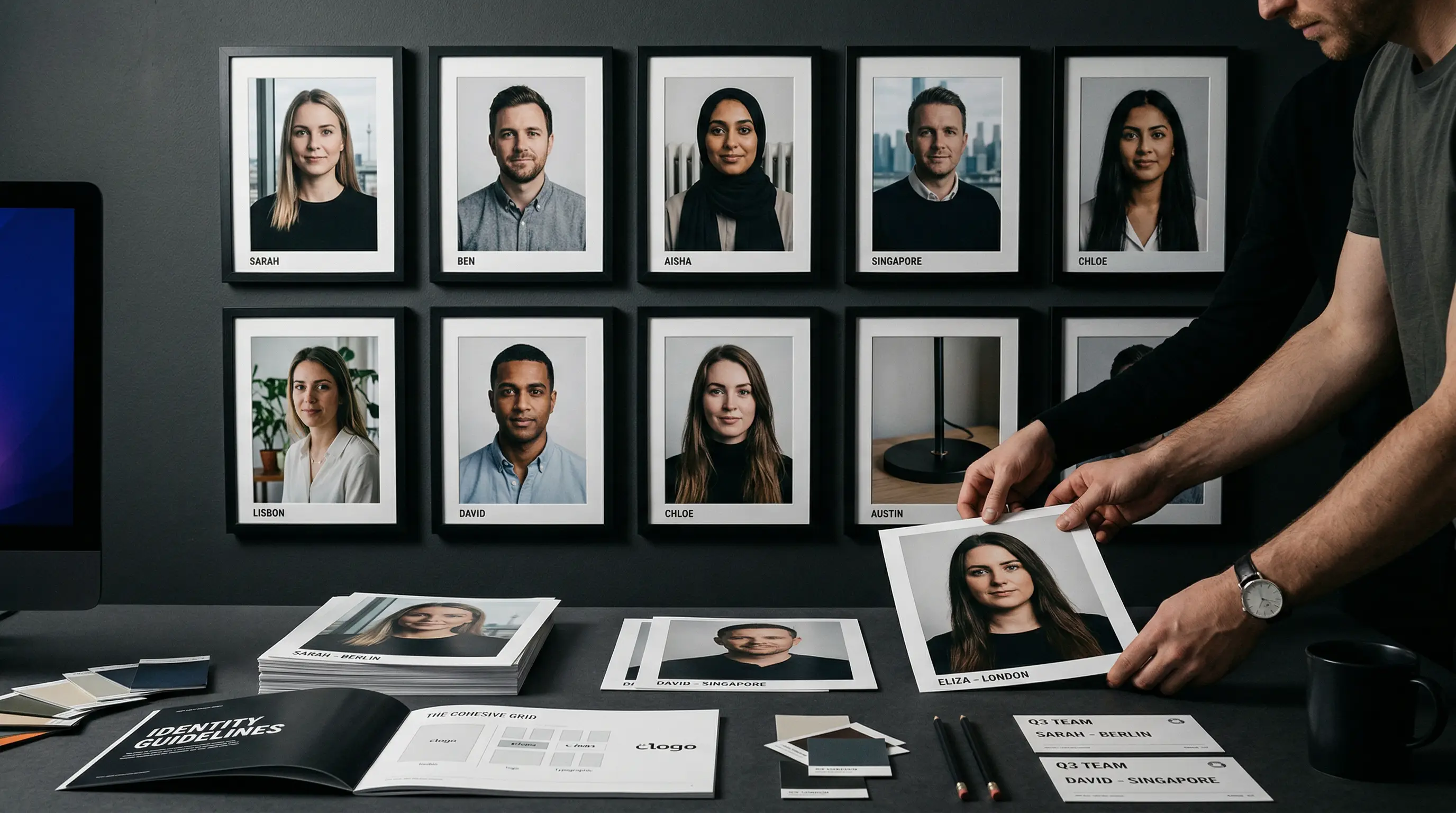
If you're evaluating AI headshots for teams, the real question is not whether remote employees can upload selfies. It's whether you can turn those uploads into one consistent visual system across Austin, Berlin, Warsaw, Lisbon, New York, London, Singapore, and the new hire starting Monday from her apartment in Toronto.
Quick answer: For most distributed companies, the fastest and most consistent way to get team headshots is to use an AI workflow with one locked background/style, async employee uploads, and a single review pass. It usually cuts rollout time from 4-6 weeks to about 5-7 business days while keeping every profile photo visually aligned.
New to AI headshots? Read our complete guide to AI headshots—how they work, what they cost, and when to use AI vs a photographer.
Now try getting them all matching headshots.
If you're managing a distributed team, you already know the drill. Someone creates a spreadsheet. Emails go out to 15+ local photographers across different time zones. Brand guidelines get lost in translation. Three months later, your "team" page looks like a collage from different decades—warm golden lighting from the New York shoot, flat cool tones from London, and a completely different background shade from Singapore.
The traditional approach to team headshots assumes everyone works in one building. That assumption describes 21% of remote-capable employees, according to Gallup's 2025 workforce data. Everyone else—79% of knowledge workers—spends some or all of their time remote.
This post is about what actually works for modern teams. Not the fantasy of flying everyone to headquarters for a photo day. The reality of getting professional, consistent headshots for people who will never share an office.
Why AI Headshots for Teams Beat Traditional Distributed Photography
Let's start with what breaks.
The Consistency Problem
You hire professional photographers in each city. You send detailed brand guidelines: white background, soft lighting, business casual attire. The results still look like they came from different companies.
I reviewed headshots from a 65-person consulting firm with offices in New York, Chicago, London, and Singapore. They'd done everything right—vetted photographers, clear briefs, quality professionals in each city. The New York shots had warm, golden lighting. London was cool and flat. Singapore used a subtly different background shade. Chicago landed somewhere in between.
The human variable is unavoidable. Different photographers bring different equipment, different aesthetic instincts, and different interpretations of "soft lighting." Even detailed brand guidelines can't standardize across multiple creative professionals working independently.
The Coordination Tax
Scheduling anything across time zones is painful. Scheduling something that requires booking physical service providers in each location? That's a project management nightmare.
For a 50-person team across five cities, here's what HR actually spends:
- Sourcing and vetting 5 photographers: 8-12 hours
- Scheduling coordination across time zones: 15-20 hours over 4-6 weeks
- Managing no-shows and reschedules: 3-5 hours (assume 15% conflict rate)
- Post-production quality review: 5-10 hours trying to enforce consistency
- Total coordination time: 35-50 hours
That's nearly a full work week of someone's time—just for coordination. Before paying a single photography invoice.
The New Hire Gap
Here's the one that really stings. You spend months aligning everyone's headshots. Your team page finally looks professional and cohesive. Then you hire four people in Q3—in three different cities—and you're back to placeholder silhouettes and mismatched photos.
For fast-growing companies, the team page is perpetually out of date. Traditional photography can't keep pace with distributed hiring because every new employee in a new location means finding, vetting, briefing, and scheduling yet another local photographer.
The Cost Reality
Let's run the actual numbers for a 50-person distributed team:
Direct costs:
- Photography sessions: $200-500 per person × 50 = $10,000-$25,000
- Travel costs for team members reaching nearest photographer: $2,000-$5,000
Hidden costs:
- HR coordination time (35-50 hours at $50/hour): $1,750-$2,500
- Lost productivity (2-3 hours per employee for travel, waiting, session): $5,000-$7,500
- No-show rescheduling fees and repeated coordination: $500-$1,500
Total traditional approach: $19,250-$41,500 for 50 headshots that still won't match perfectly.
And you'll repeat significant portions of this cost every time someone joins, requests a reshoot, or your brand guidelines change.
The Four Approaches to Distributed Team Headshots
Companies have tried four main approaches to solve this. Only one actually works.
Approach 1: Local Photographers in Each City
How it works: Hire photographers wherever your people are. Send brand guidelines. Hope for the best.
Reality: We covered this above. It's expensive ($200-500/person), coordination-heavy (35-50 hours), and produces inconsistent results despite everyone's best efforts.
Verdict: Works for small teams with 1-2 locations. Falls apart for truly distributed companies.
Approach 2: Fly Everyone to One Location
How it works: Bring the entire team to headquarters for a group shoot. One photographer, one setup, perfect consistency.
Reality: The napkin math is brutal. At the 2025 Global Business Travel Association average of $1,128 per domestic business trip, flying 50 people to one location costs $56,400—just for travel. Add lost productivity (2 workdays per person), hotel costs, and the actual photography.
Verdict: Perfect consistency, prohibitively expensive, logistically impossible for global teams spanning multiple continents. Best reserved for annual offsites where photos are a bonus, not the purpose.
Approach 3: Live Virtual Photography Sessions
How it works: A photographer directs each team member via video call, coaching lighting, posing, and expression while they use their own phone or laptop camera.
Reality: Better than traditional for distributed teams. No travel required, some professional guidance. But quality depends entirely on each person's camera, lighting conditions, and internet connection. Consistency suffers when one employee has a north-facing window and another is in a dim basement apartment. Costs run $50-150 per person—still expensive at scale.
Verdict: Good for executive portraits where personal touch matters. Doesn't scale well for full-team rollouts.
Approach 4: AI Headshot Platforms
How it works: Each team member uploads selfies from their phone. AI generates professional headshots with identical lighting, backgrounds, and composition—regardless of where or how the original selfie was taken.
Reality: This is the only approach that actually solves the distributed team challenge. Perfect consistency across all locations. No scheduling. No coordination. No travel. 60-second to 2-hour turnaround. $20-75 per person with volume discounts.
The AI applies identical parameters to every photo—something physically impossible when using different photographers in different cities.
Verdict: Best balance of quality, consistency, speed, and cost for distributed teams.
What the Research Says About AI Headshot Quality
A common objection: "AI headshots look fake." Early AI photography (2023-2024) earned this reputation. Six-fingered hands, glassy eyes, the uncanny valley effect. If that is the blocker inside your rollout discussion, read why most AI headshots look fake and how to avoid it first—the fix is usually better source-photo discipline and stricter realism review, not abandoning AI entirely.
The technology has advanced significantly. A 2025 survey of 500 hiring professionals found that 62% could not reliably distinguish modern AI headshots from studio photography. When shown side-by-side, the majority perceived AI-generated portraits as equally or more professional than traditional photos.
For distributed teams, AI headshots actually deliver better consistency than traditional photography—because consistency is baked into the technology. The same algorithm processes every photo with identical parameters. Not "similar" lighting and backgrounds. Identical.
The remaining quality concerns usually stem from:
- Poor source selfies: Low-resolution photos, bad lighting, or obscured faces produce worse results
- Wrong platform choice: Some AI tools prioritize speed over quality
- Unrealistic expectations: AI can enhance but not fundamentally transform appearance
When done right—with quality source photos and a capable platform—AI headshots are indistinguishable from studio photography to most viewers.
How to Roll Out AI Headshots for Teams in Days, Not Months
Here's what the actual process looks like with an AI platform for a 50-person distributed team:
Day 1: Setup (30 minutes)
- Select your brand style (background, lighting, attire guidelines)
- Upload your team roster
- Generate invite links
Day 2-3: Team Uploads (async, zero coordination)
- Team members receive email invites with clear photo guidelines
- Each person takes 10-15 minutes to capture and upload selfies
- No scheduling. No time zone conflicts. Each person uploads when convenient.
Day 4-5: Generation and Review
- AI processes all uploads (typically 15 minutes to 2 hours per person depending on platform)
- Team members review their generated headshots
- Select favorites for final download
Total elapsed time: 5-7 business days
Total coordination effort: 2-3 hours of admin work
Total cost: $1,000-$3,750 for 50 people (vs. $19,250-$41,500 traditional)
Compare that to the 4-6 weeks and 35-50 hours required for traditional distributed photography.
The Onboarding Advantage
Traditional team photography creates a perpetual catch-up problem. New hires start with placeholder silhouettes or inconsistent selfies while waiting for the next photo day.
AI headshots solve this elegantly. New employee starts Monday from their home office in Portland. By Tuesday, they have professional headshots matching the rest of the team—in the same background, lighting, and style. They're professionally integrated from day one.
For high-growth companies adding 5-10 people monthly, this eliminates the "always behind" problem entirely. Every new hire gets the same quality headshot as everyone else, immediately.
FAQ: AI Headshots for Teams
Are AI headshots for teams professional enough for a company About page?
Yes — for most companies, modern AI team headshots are professional enough for About pages, team directories, sales profiles, and internal bios when the source photos are strong and the workflow uses one consistent brand style.
How do you keep remote team headshots consistent?
The most reliable approach is to lock the background, crop, lighting style, and wardrobe guidance up front, then process everyone through the same workflow so new hires inherit the same visual rules instead of improvising with local photographers.
Should companies use AI headshots or photographers for remote teams?
Most distributed companies should use AI headshots for the broad team rollout, then reserve photographers for executives, press-facing leaders, or campaigns where exact likeness and custom art direction matter more than speed.
Addressing the Common Concerns
"What about data privacy?"
Reputable AI headshot platforms handle this explicitly:
- Encrypted upload and storage
- Automatic deletion of source photos after processing
- No use of customer photos to train public AI models
- Full commercial rights transfer to your company
- SOC 2 compliance (enterprise-grade platforms)
If your legal team reviews every SaaS contract, look for platforms with published security documentation and compliance certifications.
"Will employees participate?"
Actually, participation rates are higher than traditional photo days. In-person sessions require blocking calendar time, traveling to a studio, and physically walking into a photo shoot—barriers that produce 15-20% no-show rates.
Virtual AI headshots require 10 minutes from wherever the person already is. The participation barrier drops to nearly nothing. Most teams see 95%+ completion rates.
"What about people who hate having their photo taken?"
The camera-shy employees—the ones who "come up with a lame excuse" every time photo day rolls around—often prefer AI headshots. No photographer staring at them. No awkward posing. Just upload a few existing photos or take quick selfies in private. The anxiety-inducing elements of traditional photography are removed.
"Can we still have brand guidelines?"
Absolutely. Most platforms offer:
- Locked background choices (ensuring everyone uses the same backdrop)
- Consistent lighting presets
- Attire/style guidelines communicated in the setup process
- Post-generation editing for minor adjustments
The difference is these guidelines are enforced by the technology itself, not by hoping different photographers interpret them consistently.
Real Results: Case Studies from Distributed Teams
Tech Startup, 25 Employees, 12 Countries
- Traditional approach would have required: Coordinating with 12+ photographers, 3-4 week timeline, estimated $8,000-$15,000
- AI headshot solution: All 25 headshots completed in 2 days, perfect consistency, total cost $1,225 (95% savings)
- Additional benefit: Easy updates for 8 new hires within 3 months—zero additional coordination
Consulting Firm, 100 Employees, 5 Offices
- Traditional cost estimate: $50,000-$88,000 (photography + productivity + coordination)
- AI headshot solution: $4,900 total cost, 1 week timeline, 2 hours admin time
- Additional benefit: New hire onboarding now includes immediate professional headshots as standard
Healthcare System, High Turnover Environment
- Challenge: 50+ new hires quarterly, distributed across rural and urban locations
- Traditional approach: Impossible—rural locations lacked professional photography services
- AI headshot solution: Equal access to professional headshots regardless of location, $2,500 quarterly cost vs. estimated $25,000+ traditional
Making the Decision: Checklist for Evaluating Options
If you're evaluating approaches for your distributed team, score each option against these criteria:
Consistency (0-10): Will every headshot look like it came from the same shoot?
Scalability (0-10): How easily can you add new hires or handle team growth?
Cost Efficiency (0-10): What's the total cost including hidden coordination and productivity losses?
Speed (0-10): How quickly can you complete the entire team?
Employee Experience (0-10): How convenient and comfortable is the process for team members?
Traditional distributed photography: Consistency 4, Scalability 3, Cost 2, Speed 2, Experience 3 = 14/50
Fly everyone to HQ: Consistency 10, Scalability 1, Cost 1, Speed 4, Experience 2 = 18/50
Live virtual sessions: Consistency 6, Scalability 5, Cost 4, Speed 6, Experience 6 = 27/50
AI headshot platforms: Consistency 9, Scalability 10, Cost 9, Speed 9, Experience 8 = 45/50
The math is obvious. The only question is whether your organization is ready to move past the traditional approach.
The Bottom Line
Distributed teams aren't a temporary pandemic-era experiment. They're the permanent reality of modern work. Gallup's data shows 79% of remote-capable employees now work hybrid or fully remote. Stanford's WFH Research found that remote work accounts for 25% of all paid US workdays—and even aggressive return-to-office mandates would only reduce that to 24.5%.
Your headshot solution needs to match this reality.
The traditional approach—book photographers, coordinate schedules, chase stragglers—was designed for an era when everyone worked in the same building. It doesn't work when your team spans continents and time zones. The coordination costs alone make it economically irrational for distributed companies.
AI headshot platforms aren't just a cheaper alternative. They're the only approach that actually solves the distributed team challenge:
- Perfect consistency regardless of location
- Zero coordination overhead
- Immediate scalability for new hires
- 80-95% cost reduction
- Better employee participation rates
If you are still deciding where AI fits in your broader image workflow, start with our main guide to AI headshots and then compare the economics in AI headshots vs photographer cost comparison.
The question isn't whether AI headshots are "as good" as traditional photography. For distributed teams, they're better—because they're the only option that delivers what distributed teams actually need: professional, consistent headshots without the coordination nightmare.
Your team page deserves to look like one company, not a patchwork of different photo studios. Modern AI tools make that possible at a fraction of the traditional cost—in days, not months.
Ready to get consistent team headshots for your distributed workforce? Portrait Pro generates professional, on-brand headshots from simple selfies—perfect for remote teams who need quality without the coordination headache.
Related Articles
Executive Headshots That Command the Room
What separates a $50 headshot from a $2,000 one? We break down the psychology, wardrobe, and lighting decisions that make C-suite portraits feel expensive.
AI Product Photography Guide for Small Stores
How small stores can use AI product photography for marketplace listings, social posts, and site assets without losing consistency.
LinkedIn Headshot AI Guide for 2026
A practical guide to LinkedIn headshot AI: likeness, lighting, trust signals, usage rights, and whether the final image earns the meeting.
Ready to create images that convert?
Generate headshots, thumbnails, and covers that stay on brand—no photo shoots or design rounds.
Launch Image Studio